
By Sarah Mitchell, Certified Pediatric Sleep Consultant & Certified Lactation Counselor | Creator of The Helping Babies Sleep Method
Quick Answer: Whether you should wake a sleeping baby depends entirely on your baby's age, weight, feeding history, and current sleep schedule. This guide breaks it down clearly, age by age, nap by nap.
Why Parents Ask This Question
It's one of the most ironic questions a new parent asks — and one of my favourites.
You spent weeks desperately Googling "why won't my baby sleep" — and now here you are, asking "should I wake my sleeping baby?"
That's a win. Let's make sure you handle it right.
Whether it's a newborn snoozing through a feeding, a four-month-old napping past the schedule window, or a toddler still asleep at 4:30 pm, the answer is different every time. And most advice you'll find online treats this as a one-size-fits-all question. It isn't.
In this post I'll walk you through exactly how I coach my clients through this — by age, by time of day, and by what the evidence actually says.
The Four Questions to Ask Before You Wake Your Baby
Before you touch that crib, ask yourself:
- How old is your baby? A two-week-old newborn and a ten-month-old require completely different approaches.
- Is there evidence that letting them sleep will cause a problem? Not a feeling — actual evidence from your own baby's patterns.
- Do you have a fixed schedule, or are you winging it? Your answer changes depending on where you are in your sleep journey.
- What time of day is it? An early morning sleep-in is very different from a 5 pm nap disaster.
Newborns Under 3 Months: Feed First, Sleep Second
The First Month Is About Feeding — Full Stop
In my training as a Certified Lactation Counselor, and in over a decade of working with families through The Helping Babies Sleep Method, I have always maintained that the first month of life is primarily about feeding. Whether you're breastfeeding or formula feeding, your primary job is:
- Establishing feeding patterns
- Ensuring adequate weight gain
- Building milk supply (if breastfeeding)
Two factors drive milk supply in breastfeeding parents:
- Nipple stimulation — frequent feeding triggers oxytocin and prolactin release
- Milk removal — emptying the breast signals the body to produce more, whether through nursing or pumping
📖 We cover intentional feeding strategies in depth in The Helping Babies Sleep Method — an Amazon bestseller trusted by thousands of families.
🔗 Understand how the newborn sleep system works based on science: Understanding Newborn Sleep Science To Help Your Baby Sleep -->
When Can You Stop Waking a Newborn to Eat at Night?
According to the American Academy of Pediatrics, healthy, growing babies generally do not need to be woken for nighttime feedings — though parents should always check with their pediatrician if they have concerns about weight gain."
Source: HealthyChildren.org — Sleeping Through the Night
It really depends on your feeding source and your particular situation.
General guidelines for stopping scheduled nighttime wake-ups:
- ✅ Baby has regained birth weight and is gaining consistently (usually by 4–6 weeks)
- ✅ Baby regularly goes 3–4 hours between feedings at night without showing hunger cues
- ✅ Baby is producing 6–8 wet/heavy diapers per day by day six onward
- ✅ Baby is showing longer natural stretches — 5 to 6 hours
- ✅ Your pediatrician has cleared you to let baby lead at night
La Leche League International supports this position, noting that during the first few weeks, babies sleeping deeply may need encouragement to feed every 2–3 hours — but after this window, healthy, well-gaining babies do not need to be woken.
⚠️ Preemies and babies with documented feeding or weight challenges are exceptions. Always follow your pediatrician's specific guidance.
Daytime Naps for Newborns: My Preferred Approach
Here is where I part ways with the popular "don't let your newborn sleep more than two hours" rule.
Why I dislike the 2-Hour Daytime Rule:
Research shows newborns (0-28 days in this study) sleep in natural 3–4 hour chunks around the clock. Their sleep is weakly regulated — meaning their bodies are running on internal cues, not a clock. Capping a newborn's nap at two hours, when they may be mid-cycle and capable of a 3-hour stretch, keeps tired parents stuck in an overtired loop.
💡 In The Helping Babies Sleep Method, we teach that the 2-hour rule only suits babies who are already sleeping well. Most parents searching for sleep help don't fall into that category.
What I recommend instead:
- Wake your newborn during the day only if they are sleeping past a feed (3–3.5 hours since the last full feed)
- Prioritise getting calories in during daylight hours — this is what I call intentional feeding, or Pillar 3 of the HBS Method
- A well-fed, well-rested baby in the daytime sleeps better at night
- At night, if baby is gaining weight, do not wake them — let them lead
🔗 Understand The Helping Babies Sleep Method : The Helping Babies Sleep Method
🔗 Understand why feeding and sleep are inseparable: The Feeding and Sleep Connection →
🔗 Learn why fixing feeding must come before sleep training: Why Sleep Training Fails Without Fixing Feeding First →
Can a Newborn Sleep Too Much in the Daytime?
In most cases, no. Hunger will typically wake a healthy newborn.
When daytime sleep is excessively long, it's worth looking at the full 24-hour sleep picture — not dividing it into daytime and nighttime buckets. Factors that can increase daytime sleep needs include:
- Frequent night waking due to discomfort (gas, reflux)
- Low milk supply causing more nighttime feeds and poorer quality sleep
- Prematurity requiring higher overall sleep volume
- Recovery from illness or a developmental leap
🔗 See how the snacking cycle affects nighttime sleep: The Snacking Cycle: Daytime Feeding and Night Sleep →
Morning Wake Times for 0–3 Month Olds
Should You Wake Your 2-Month-Old in the Morning?
Your 2-month-old needs 14-17 hours of sleep per 24-hour period. They likely still feed around 4–5 am. If a late morning feed pushes past 6 am, I recommend waking by 7:00–7:30 am to anchor the start of the day.
A consistent daily wake time — within 30 minutes either direction — helps stabilise your bedtime window, which benefits the whole family. Just like adults if they wake up later in the day, their bodies might not be ready to sleep at their “usual bedtime.”
Should You Wake Your 3-Month-Old in the Morning?
At three months, a shift begins. Circadian rhythm is developing with the production of melatonin, the witching hour often starts to ease, and bedtime is getting earlier and more predictable.
General guideline for 0–3 months: Start the day between 6:30–7:30 am with a feed. Aim for consistency.
🔗 Ready to understand the bigger picture of your baby's sleep development? The Helping Babies Sleep Method Explained →
4–6 Months: The Circadian Shift Changes Everything
Around four months, multiple shifts occur.
- Your baby's circadian rhythm takes another leap. It will be fully mature by 6 months of age.
- Their sleep architecture has changed to full incorporate light sleep cycles that were absent in months 1 and 2.
- They become far more aware of their environment, and are learning object permanence. Realizing that you exist even when they can’t see you.
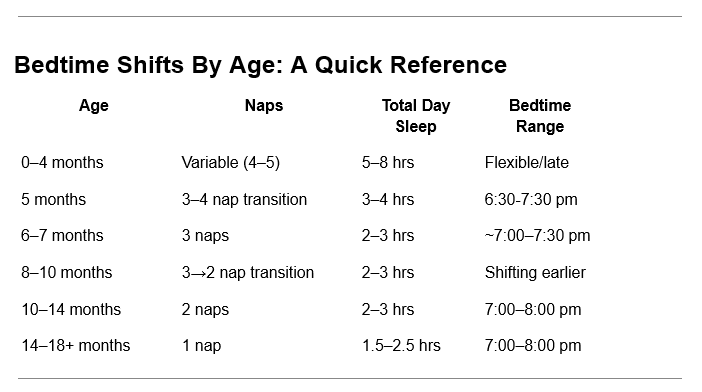
At this age, well rested babies typically wake naturally between 6–7 am, and settle into a bedtime of around 6:30–7:30 pm. They tend to nap 3-4 hours per day and 11-12 hours overnight.
This is also when the 4-month sleep regression occurs — a permanent neurological shift in sleep architecture from newborn-style sleep to more adult-like cycles. It's not a phase that passes. It's a change that requires a response.
🔗 Understand more about the 4 month sleep regression: The 4 Month Sleep Regression →
When to Wake From Naps at 4–5 Months
There are two primary reasons to wake a baby from a nap at this age:
- To stack calories during the day and prevent feeding from shifting to nighttime unnecessarily
- To protect the bedtime window — a late last nap pushes bedtime dangerously late
Guideline: Wake from the last nap by 5:30 pm so bedtime falls before 7:30 pm.
🔗 Age-specific sleep guidance for 5 month olds: What You Need To Know About Your 5 Month Old's Sleep-->
6–7 Months: Three Naps and a Stable Schedule
By six months, the circadian rhythm is fully mature. Your baby is consistently on three naps and needs 2–3 hours of total daily nap time and continued 11-12 hours overnight.
Guideline: On three naps, wake from the last nap by 5:00 pm so bedtime falls around 7:30 pm.
I would not wake a baby from a nap at this stage unless there is clear evidence it is disrupting night sleep or pushing bedtime excessively late.
🔗 Age-specific guidance for 6–7 month olds:
View the 6 Month Sleep Guide →
View the 7 Month Sleep Guide →
8–13 Months: The Two-Nap Stage
When Your Baby Is Consistently on Two Naps
Your daily nap goal is 2–3 hours total, with roughly 11–12 hours of overnight sleep.
Two get to 2 naps you need to achieve a few criteria:
- Baby can connect nap cycles. Naps need to be longer than 30 minutes.
- They need to tolerate a 3 hour awake window.
- They need to be able to consistently sleep to 6:30 am or later.
In a two-nap structure:
- First nap: 45 minutes to 1.5 hours
- Second nap: typically the longer of the two, 1 to 2 hours
If the first nap runs long (1.5 hours) and the second nap may be shorter — either in fall-asleep time or duration — this is a stage where we might cap the first nap at 1.5 hours to protect the afternoon nap.
💡💡Key Tip: You want the second nap to start no later than 3 pm as it can become more challenge to initiate sleep at this stage on a 2 nap schedule.
Guideline: Wake from the second nap by 3:00–4:00 pm depending on age, so bedtime falls between 7:00–8:00 pm.
🔗 Read more about the 3-2 Nap Transition: View 3-2 Nap Transition
🔗 Read more about a 9 Month old schedule: 9 Month Schedule
🔗 Read more about a 10-11 Month old schedule: 10 and 11 Month Schedule
🔗 Read more about a 12-13 Month old schedule: 12-13 Month Schedule
14–18+ Months: The One-Nap Toddler
Protect That Nap at All Costs
The single nap is precious. Losing it — even partially — can unravel the rest of the day.
What I recommend:
- In general, don't let your toddler nap past 4:00–4:30 pm
- If a late start pushed naptime to 3:00 pm instead of the usual 1:00 pm, wake by 4:30 pm
- The exact cut-off shifts based on your child's bedtime — a child who sleeps 8 pm to 7 am can tolerate a slightly later nap than one who sleeps 7 pm to 6 am
The dreaded car nap: A 30-minute car nap often counts as the full nap in a toddler's mind. Protect your nap window by timing car trips away from nap time when possible or stay in the car until nap is at least 1.5 hours. They will wake up on transfer.
How to Wake a Toddler From a Nap
- Open the curtains slowly
- Gently rouse them and then leave the room — give them space to "come to" naturally
- Return gently if needed
- The goal is for them to feel like they woke up on their own
🔗 Age-specific guidance to transition down to 1 nap around 14 - 15 months: View the One Nap Transition Guide
What About Dreamfeeds?
A dreamfeed — where you pick up a sleeping baby and offer a feed before they wake and ask for one — serves different purposes in the newborn stage versus the “sleep teaching stage” and different ages. It is not the same as demand feeding. We break down dreamfeeds in detail in a dedicated post.
🔗 Age-specific guidance to transition down to 1 nap around 14 - 15 months: When And How to Dreamfeed
Our Core Philosophy
"I don't like to wake a sleeping baby because if they're sleeping, they need it."
Sleep is not passive. While your baby rests, their body is:
- Processing language development
- Laying down long-term memory
- Releasing growth hormone
- Regulating the immune system
- Integrating motor milestones
Behavioral sleep research consistently supports that uninterrupted, consolidated sleep is critical for infant cognitive and physical development. I only recommend waking when there is clear, observable evidence that sleeping longer will negatively impact another part of their sleep pattern — or when medical guidance requires it.
🔗 Want to understand why common sleep advice often backfires? Why "Drowsy But Awake" Fails →
🔗 Baby 4 months or older? Comparing sleep training approaches? Ferber vs. CIO vs. The HBS Method →
📚 Get the Full Framework
Like this philosophy? Everything in this post — the feeding strategy, the nap approach, the age-by-age schedule, and the method behind it all — is laid out step by step in:
The Helping Babies Sleep Method — Amazon Bestseller
It teaches you how to be a great baby detective for sleep and feeding, and it debunks the most common myths that keep exhausted parents stuck.
❓ Frequently Asked Questions
Q: Should I wake my newborn to feed at night?
A: In the first 2–3 weeks, yes — until baby has regained birth weight and is gaining consistently. After that, the AAP and La Leche League both support allowing healthy, well-gaining newborns to sleep without being woken for feeds. Always follow your pediatrician's specific advice.
Q: Will a long daytime nap ruin night sleep?
A: Rarely, especially in newborns. A well-rested baby generally sleeps better, not worse. The exceptions are late naps that push bedtime past the optimal window, or excessive total daytime sleep in older babies on structured schedules. Newborns who seem to take “monster” naps in the daytime are usually recovering from a lack of nighttime sleep, often due to gas/reflux/discomfort.
Q: What is the "2-hour nap rule" and should I follow it?
A: The 2-hour rule advises waking newborns after two hours of daytime sleep. We don't teach this in The Helping Babies Sleep Method. Newborns naturally sleep in 3–4 hour chunks and capping naps often increases overtiredness. We recommend waking to feed only — not to an arbitrary time limit. For babies 4 months and older, you can use the 2 hour rule. We prefer to focus on feeding - keeping feeding in set windows and wake them because they are sleeping through a feeding time.
Q: My baby is sleeping past 7 am — should I wake them?
A: For babies 0–3 months, gently anchoring the day by 7:00–7:30 am can help stabilise your schedule. For older babies, that 7 am or 7:15 am wake is a reasonable wake up time and helps protect your bedtime by keeping it in that 7 -8 pm range. When reading things online about bedtime make sure you’re also considering daily wake uptime. A baby who wakes up at 9 am because they nursed to sleep from 7 -9 am will not be ready to sleep at 7 pm.
Q: When should I wake my baby from a nap?
A: It depends on age and nap number. The primary reasons to wake from a nap are: (1) to protect the bedtime window, and (2) to ensure adequate daytime calories. See the age-by-age guidelines above. Waking kids from a nap is to help the next sleep window rather than “letting them nap too long” because it will impede their night sleep. It’s about readying their body for the next sleep period. Allowing sleep pressure to optimize before the next sleep.
Q: Does sleep really affect development?
A: Yes — significantly. Infant sleep is when growth hormone is released, neural connections are formed, motor skills are consolidated, and immune function is regulated. Behavioural sleep medicine frameworks, including those cited by the AAP, consistently support consolidated sleep as foundational to healthy development.
Q: How do I know if I need a sleep consultant?
A: If you've tried adjusting schedules and sleep training approaches on your own without lasting results, a certified sleep consultant can identify the root cause — often a feeding or scheduling issue that's being missed. Learn what to look for when choosing one →
References & Entities
- American Academy of Pediatrics (AAP) — Breastfeeding and the Use of Human Milk Policy Statement; Safe Sleep Recommendations 2022; Pediatrics Vol. 129 No. 3
- La Leche League International (LLLI) — Frequency of Feeding Guidelines; Sleep and the Breastfeeding Family
- Sleep Foundation — Infant Sleep Cycles: How Are They Different From Adults?
- Cleveland Clinic — Wake Windows by Age
- Behavioral sleep medicine frameworks — including Graduated Extinction (Ferber), Extinction (CIO), and the Helping Babies Sleep Method
- The Helping Babies Sleep Method by Sarah Mitchell — Available on Amazon
Have questions about your specific baby? Work with Sarah or a team member directly →